Electric skateboards used to force a hard choice. Cheap boards felt like toys. Any board that actually worked well cost well over one thousand dollars.
That gap has closed fast. In 2026 even boards under $300 come with two motors, real brakes, and double digit mile ranges. The $500 to $1000 range now matches what expensive flagship boards offered just a few years ago.
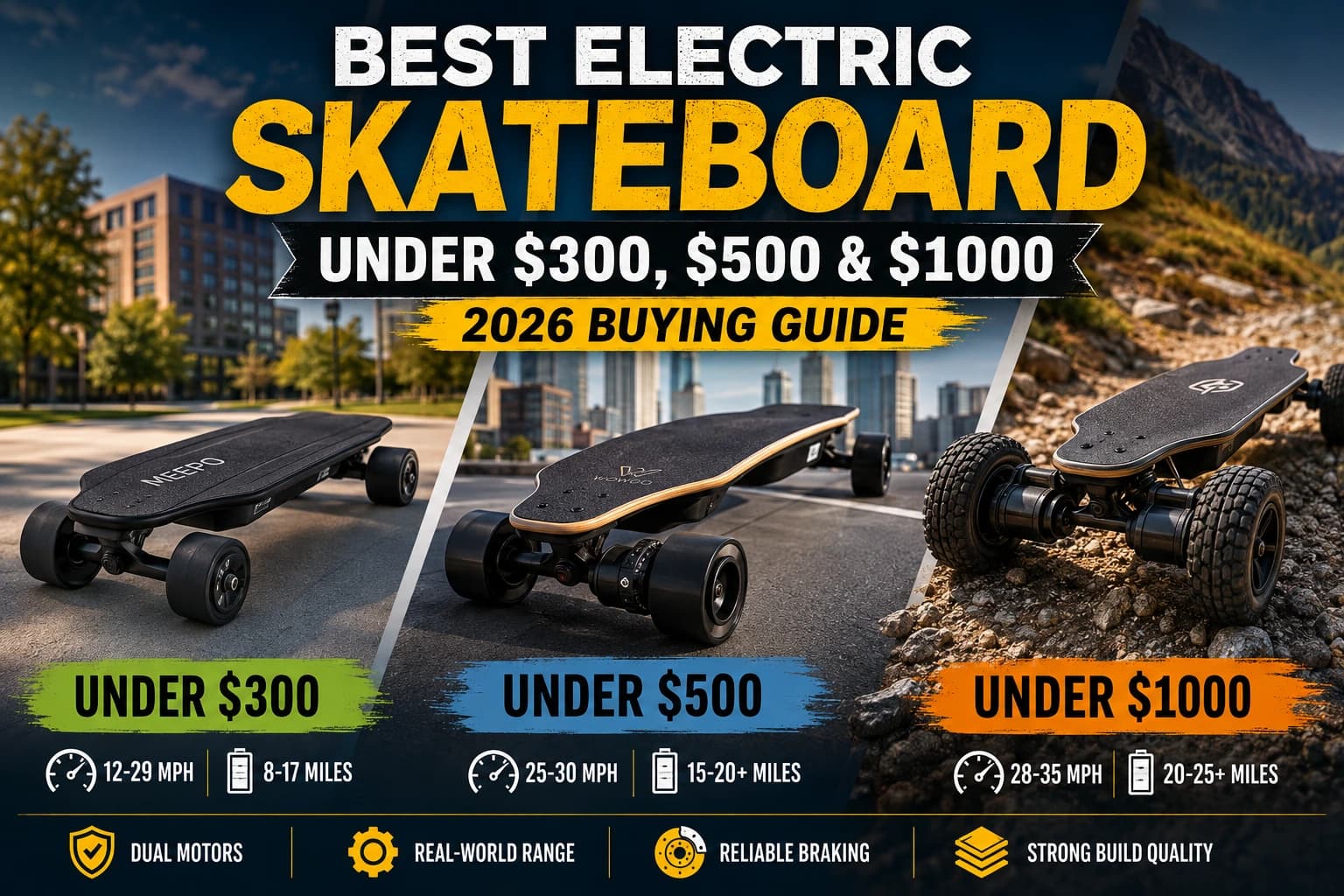
This guide divides the market into three clear budgets: under $300, under $500, and under $1000. This will help you learn what you get at each price point and which board fits your riding style.
Which Budget Should You Pick?
Under $300: Best if you want a cheap way to try electric skateboarding, or if you need a light board for short campus or work trips.
Under $500: The best choice for most riders. You get dual motors, a 15 to 20 mile range, and parts that hold up to daily riding.
Under $1000: Built for riders who already know they love electric skateboarding. These boards offer more power, better comfort with larger wheels or suspension, and gear drive systems that need less care than belts.
How We Are Judging These Boards
Before looking at the top picks, it helps to know what makes a good budget board:
Motor type: Hub motors sit inside the wheels. They are quiet and need almost no care. Belt drives give more power for climbing hills, but you must tighten the belts sometimes. Gear drives combine strong power with low care.
Real-world range: The range advertised by makers is almost always too high. A board rated for 20 miles will usually give you 60% to 80% of that number when you add rider weight, hills, and riding style.
Braking: Smooth and predictable braking is more important than top speed. Sudden or jerky brakes are a common problem on cheap boards.
Build quality: Strong maple wood decks, water resistant parts, and a smooth wireless remote make a board worth buying.
Best Electric Skateboards Under $300
At this price you are looking at entry level boards. The under $300 group has changed from cheap toys to real short commute tools. Brands like Meepo, Tynee, WowGo, and Hiboy make good boards in this tier.
What to Expect Under $300
Top speeds between 12 and 29 mph depending on the model
Around 8 to 17 miles of real range
A mix of single and dual hub motor setups
Decent build quality, but thinner batteries and simple speed controllers
1. Meepo Mini5
A small cruiser made for daily riders. It has a high top speed and enough range for short daily trips. It is a great choice if low weight and price matter more than raw power.
Best for: Short trips and easy carrying.
Pros: Very light, good speed, affordable.
Cons: Small wheels make rough roads bumpy.
2. Hiboy S22
Brings smooth dual motors to the budget tier. This is rare for a board under $300. It is a solid and safe choice for a first board.
Best for: First time riders.
Pros: Dual motors, smooth ride, low price.
Cons: The range is on the shorter side.
3. iSinwheel V6
A lighter and smaller board that is easy to carry around. It uses a smaller battery to match its small frame.
Best for: Students and quick rides.
Pros: Easy to carry, compact build.
Cons: Smaller battery capacity.
Who this budget is for: First time riders who are not sure if electric skateboarding is for them, students who need a light board, or anyone who wants a cheap way to start.
The trade-off: Thinner batteries mean shorter range. Brakes can feel a bit rough compared to $500 boards. If you weigh over 200 pounds or ride on big hills, you should save for the next budget level.
Best Electric Skateboards Under $500
This is where the market has improved the most. Boards under $500 in 2026 match what used to cost $800 or more. Dual hub motors are now standard.
What to Expect Under $500
Top speeds around 25 to 30 mph on faster models
Real range between 15 and 20 miles thanks to bigger battery packs
Better speed controllers for smoother starting and stopping
Nice extras like deck lights, strong trucks, and swappable battery designs
1. WowGo 2S Max
One of the most recommended boards in this group. It uses a reliable speed controller and dual 550W motors.
Best for: Daily commuters.
Pros: Reliable motors, long life, smooth acceleration.
Cons: Can slow down on steep hills.
2. Tynee Mini 3 Pro / Mini 3 SL
Known for great range, good battery quality, and helpful customer support when you need spare parts.
Best for: Riders who want good battery life and great customer service.
Pros: Excellent range, great support, strong motors.
Cons: Small board shape can feel twitchy at high speeds.
3. Cyber Mini / Cyber Mini Air
Offers high end features like strong forged trucks and built-in lights under $500. The frame protects the electronic parts well.
Best for: Riders who want built-in lights and strong parts.
Pros: Good trucks, built-in lights, safe battery design.
Cons: A bit heavy for its size.
Who this budget is for: Daily commuters, anyone riding more than a few miles at a time, and buyers who want a board they will not outgrow in six months.
The trade-off: Most boards still use hub motors. That means less hill power than belt or gear drive boards. If your commute has steep hills, check the motor wattage before you buy.
Best Electric Skateboards Under $1000
When you spend up to one thousand dollars, the biggest upgrade is ride comfort and power delivery. This is where gear drives, suspension systems, and true all-terrain boards show up.
What to Expect Under $1000
Gear drive or strong belt drive systems that offer more power and need less care than cheap belt setups
Air-filled tires that smooth out cracks and rough roads much better than hard rubber wheels
Suspension systems that soak up bumps
Bigger batteries built for long daily trips
1. Propel Endeavor3 S (~$999)
A real all-terrain board with suspension and big tires. It is built for rough roads and dirt trails rather than smooth city streets.
Best for: Rough roads and off-road riding.
Pros: Full suspension, big tires, super comfortable.
Cons: It is heavy and hard to carry.
2. Acedeck Nomad N1 (~$999)
Known for smooth power and great stability at high speeds. Its range matches boards that cost much more.
Best for: Fast riding and long distances.
Pros: Very stable, long range, smooth power delivery.
Cons: Higher price point.
3. WowGo AT2 Plus (~$899)
Uses air-filled tires and a smooth power feel. This makes it one of the most comfortable boards for long all-day rides.
Best for: Comfortable all-day riding.
Pros: Soft tires, smooth ride, easy controls.
Cons: Large size makes it hard to store or carry.
4. Tynee Ultra X Pro (~$799)
A lighter board in this price tier at under 23 pounds. It is made for riders who want high speed without the heavy weight of a full all-terrain board.
Best for: Riders who want high performance in a lighter package.
Pros: Light weight, strong power, easy to carry.
Cons: Does not smooth out bumps as well as big tire boards.
Who this budget is for: Experienced riders upgrading from a cheap board, commuters who want an all-terrain option, and anyone who wants a board that handles rough roads, gravel, and light dirt.
The trade-off: These heavy boards sacrifice easy carrying. If you must carry your board upstairs or inside buildings often, weight is an important factor.
Electric Skateboard Comparison at a Glance
| Budget | Typical Top Speed | Typical Real-World Range | Motor Type | Best For |
|---|---|---|---|---|
| Under $300 | 12–29 mph | 8–17 miles | Single/dual hub | First-time riders, campus commuting |
| Under $500 | 25–30 mph | 15–20+ miles | Dual hub (premium speed controller) | Daily commuters |
| Under $1000 | 28–35 mph | 20–25+ miles | Gear drive / premium belt | Experienced riders, all-terrain use |
Safety Reminders Before You Ride
No matter your budget, a few safety rules always matter:
Wear a good helmet. Think about a full face helmet if you ride over 30 mph.
Start on the lowest speed setting for your first few rides. Most falls happen when you are new.
Wrist guards and gloves are worth wearing. Wrist injuries are very common.
Check local laws. Rules for electric skateboards change by city and state.
Frequently Asked Questions
Is a $300 electric skateboard worth it, or should I save up?
If you are not sure if you will stick with electric skateboarding, a board under $300 is a good way to find out without spending too much money. If you already know you will commute daily or ride long distances, saving for the $500 group will save you money over time because you will not need an early upgrade.
What is the real difference between hub motors and belt or gear drives?
Hub motors sit inside the wheel. This makes them quiet and free of care, but they offer less power for hills. Belt drives and gear drives deliver more climbing power and are common in the $500 to $1000 range. Gear drives give the best combination of power and low care.
How much range do I actually get, not just what is advertised?
Plan on 60% to 80% of the advertised range during real riding. A board advertised at 20 miles will realistically give you 12 to 16 miles depending on your weight, the road, and how fast you ride.
Do I need a $1000 board if I am just commuting on flat city streets?
No you do not. A well reviewed $500 board with dual hub motors is usually enough for flat streets. Moving up to $1000 is best if you deal with steep hills, rough pavement, gravel, or long distances.
What size rider do these boards support?
Most budget and middle range boards list a maximum rider weight between 220 and 330 pounds. But power and range drop as you get closer to that limit. If you are near the upper limit, look for boards with higher power dual motors.
Final Take
Choosing a good electric skateboard depends on your daily commute and your budget. If you are brand new to the sport, a board under $300 like the Meepo Mini5 is a great way to start. For daily commuting, a $500 board like the WowGo 2S Max gives you the best value. If you want to ride on all kinds of rough roads, a $1000 board like the Propel Endeavor3 S delivers unmatched comfort.
Frequently Asked Questions
A: If you are not sure if you will stick with electric skateboarding, a board under $300 is a good way to find out without spending too much money. If you already know you will commute daily or ride long distances, saving for the $500 group will save you money over time because you will not need an early upgrade.
A: Hub motors sit inside the wheel and are quiet and low-maintenance. Belt and gear drives generally deliver more climbing power. Gear drives offer a combination of strong power and low maintenance.
A: Plan on around 60% to 80% of the advertised range during real riding, depending on rider weight, road conditions, hills, and riding speed.
A: No. A well-reviewed $500 board with dual hub motors is usually enough for flat streets. Moving toward $1000 makes more sense for steep hills, rough pavement, gravel, or long distances.
A: Most budget and middle-range boards list maximum rider weights between 220 and 330 pounds, but power and range can decrease as you approach the limit.